Senin, 11 Februari 2008

Strategies For Real Estate

Download here

Get the secret how the richest real estate investor do the business. Download for free now!

The Millionaire Next Door

Download here

How can you join the ranks of America's wealthy (defined as people whose net worth is over one million dollars)? It's easy, say doctors Stanley and Danko, who have spent the last 20 years interviewing members of this elite club: you just have to follow seven simple rules. The first rule is, always live well below your means. The last rule is, choose your occupation wisely. You'll have to buy the book to find out the other five. It's only fair. The authors' conclusions are commonsensical. But, as they point out, their prescription often flies in the face of what we think wealthy people should do. There are no pop stars or athletes in this book, but plenty of wall-board manufacturers--particularly ones who take cheap, infrequent vacations! Stanley and Danko mercilessly show how wealth takes sacrifice, discipline, and hard work, qualities that are positively discouraged by our high-consumption society. "You aren't what you drive," admonish the authors. Somewhere, Benjamin Franklin is smiling

Good to Great

Download Here

Editorial Reviews

Amazon.com's Best of 2001
Five years ago, Jim Collins asked the question, "Can a good company become a great company and if so, how?" In Good to Great Collins, the author of Built to Last, concludes that it is possible, but finds there are no silver bullets. Collins and his team of researchers began their quest by sorting through a list of 1,435 companies, looking for those that made substantial improvements in their performance over time. They finally settled on 11--including Fannie Mae, Gillette, Walgreens, and Wells Fargo--and discovered common traits that challenged many of the conventional notions of corporate success. Making the transition from good to great doesn't require a high-profile CEO, the latest technology, innovative change management, or even a fine-tuned business strategy. At the heart of those rare and truly great companies was a corporate culture that rigorously found and promoted disciplined people to think and act in a disciplined manner. Peppered with dozens of stories and examples from the great and not so great, the book offers a well-reasoned road map to excellence that any organization would do well to consider. Like Built to Last, Good to Great is one of those books that managers and CEOs will be reading and rereading for years to come. --Harry C. Edwards

From Publishers Weekly
In what Collins terms a prequel to the bestseller Built to Last he wrote with Jerry Porras, this worthwhile effort explores the way good organizations can be turned into ones that produce great, sustained results. To find the keys to greatness, Collins's 21-person research team (at his management research firm) read and coded 6,000 articles, generated more than 2,000 pages of interview transcripts and created 384 megabytes of computer data in a five-year project. That Collins is able to distill the findings into a cogent, well-argued and instructive guide is a testament to his writing skills. After establishing a definition of a good-to-great transition that involves a 10-year fallow period followed by 15 years of increased profits, Collins's crew combed through every company that has made the Fortune 500 (approximately 1,400) and found 11 that met their criteria, including Walgreens, Kimberly Clark and Circuit City. At the heart of the findings about these companies' stellar successes is what Collins calls the Hedgehog Concept, a product or service that leads a company to outshine all worldwide competitors, that drives a company's economic engine and that a company is passionate about. While the companies that achieved greatness were all in different industries, each engaged in versions of Collins's strategies. While some of the overall findings are counterintuitive (e.g., the most effective leaders are humble and strong-willed rather than outgoing), many of Collins's perspectives on running a business are amazingly simple and commonsense. This is not to suggest, however, that executives at all levels wouldn't benefit from reading this book; after all, only 11 companies managed to figure out how to change their B grade to an A on their own.

Copyright 2001 Cahners Business Information, Inc.

The Way To The Top

Download Here

Editorial Reviews
From Publishers Weekly
Acknowledging that "you can’t know it all," tough-minded businessman and recent television star Trump asked more than 100 successful businesspeople to tell him "the best business advice they have ever received." His newest volume compiles their responses into easily digestible tidbits that range from the realistically prescient ("The sun doesn’t shine forever," from Barbara Berger, president of Food City Markets) to the stoically practical ("Don’t confuse efforts with results," Thomas J. Barrack, CEO of Colony Capital). Though most of the book’s entries are no longer than half a page, a few contributors, such as Barbara Corcoran (founder of the Corcoran Real Estate Group) and Thomas Chen (president of Crystal Window and Door Systems), have written longer entries that reveal as much about their authors as they do about good business sense. Serious readers of business books may be disappointed by some of more lackluster contributions (e.g. "the secret of having a good business is to be in a good business"), but there are enough sage words here to satisfy most fans of The Apprentice.
Copyright © Reed Business Information, a division of Reed Elsevier Inc. All rights reserved.

Book Description
The host of the hit reality show The Apprentice presents an invaluable collection of grounded, hard-hitting advice on business success, from people who have made it to the boss’s chair at some of America’s most thriving companies.

How can you find the way to the top?

Ask people who are already there.

Because you can’t know it all. No matter how smart you are, no matter how comprehensive your education, no matter how wide-ranging your business experience, there’s simply no way to acquire all the wisdom you need to make your business flourish. You need to learn from those who have blazed a trail before you.

Donald Trump has asked many of the brightest, most successful businesspeople he knows—and some he doesn't know—to answer this question: What's the best business advice you ever received? The result is a compelling resource of wisdom and wit that reveals how some of the most accomplished people conduct their personal and business affairs, giving an inside look into the secrets of corporate success. But the advice doesn’t only come from the upper echelons of the Fortune 500. Thoughts poured in from executives at thriving companies large and small, ranging from well-known icons such as Staples, American Airlines, Lillian Vernon, and Boeing to family-run operations like Orleans Homebuilders and Carlson Companies.

The Way to the Top brings together the core ideas that have guided more than 150 of today’s top businesspeople, offering a range of inspiring and practical advice on making good decisions, conducting yourself appropriately, developing your career, communicating with others, leading a team effectively, and much more. Some of the entries are simple entreaties, some portray intriguing vignettes, and others outline lists of guiding principles; all are illuminating, instructive, and insightful.

A telling to-do list for the aspiring professional, The Way to the Top belongs on every business bookshelf.

Learning Into Six Sigma

Download Here

Editorial Reviews

Book Description

A brief business novel about combining today's two most powerful quality initiatives

Leaning Into Six Sigma shows managers how to combine today's two most popular continuous improvement methodologies-- Lean Enterprise and Six Sigma--for dramatically improved quality and cycle time.

This concise and fast-paced "business novel" tells the story of how one skeptical company gradually came to understand and implement a Lean Six Sigma initiative--improving quality at all levels of the organization. This engaging story will help employees and managers understand basic quality concepts from Design of Experiments (DOE) to Analysis of Variance (ANOVA), while learning how to:

  • Implement work cells and preventive maintenance
  • Get rid of excess inventory
  • Speed up processes


Book Info
This concise and fast-paced business novel tells the story of how one skeptical company gradually came to understand and implement a Lean Six Sigma initiative--improving quality at all levels of the organization. Softcover.

The Essential Drucker

Download Here

Editorial Reviews
Amazon.com's Best of 2001
Ever since his first book was published some six decades ago, Peter Drucker has been essential to everyone serious about the "management of an enterprise (and) the self-management of the individual, whether executive or professional, within an enterprise and altogether in our society of managed organizations." This distinguished 30-year Claremont University professor has continuously identified critical principles in management, economics, politics, and the world in general. And he has redirected our thinking about them through more than two dozen books, including an autobiography and a couple of works of fiction. Now, with The Essential Drucker, he has overseen the compilation of his most important fundamentals into one indispensable book. Reaching back as far as 1954 with his treatise "Management by Objectives and Self-Control" ("Each manager, from the 'big boss' down to the production foreman or the chief clerk, needs clearly spelled-out objectives" that clarify expected contributions "to the attainment of company goals in all areas of the business"), Drucker's now-established ideas take on a surprising new relevancy when remixed equally pioneering ideas from the 1960s, '70s, '80s, and '90s. Between the thoughtful "Management as Social and Liberal Art" through the provocative "From Analysis to Perception--The New Worldview" (both originally published in 1988's The New Realities), this book revisits some of modern management's most inspired writing and presents it in a way that should appeal to both newcomers and those needing a refresher course on Drucker's basic beliefs. --Howard Rothman

From Booklist
More Drucker! While the prolific nonagenarian and acclaimed management philosopher continues to write--Management Challenges for the 21st Century (1999) is his most recent book--he and others have also been busy compiling and summarizing his most noteworthy work. Peter Drucker on the Profession of Management (1998) is a collection of 13 significant articles that have appeared in the Harvard Business Review. John Flaherty, in Peter Drucker: Shaping the Managerial Mind (1999), and Jack Beatty, in The World According to Peter Drucker (1998), both penned biographical portraits and bibliographic essays that are homages to Drucker and his thoughts. Now Drucker himself has picked 26 selections that consist of chapters excerpted from 10 of the 29 books he has written over the past 60 years. His goal is to offer a "coherent and fairly comprehensive Introduction to Management" and to help those interested in learning more about his ideas determine "which of his writings are [most] essential." David Rouse
Copyright © American Library Association. All rights reserved

Made in America

Download Here

From Library Journal
The late Sam Walton was one of the shrewdest and richest merchants in America. Centered on the building of his Wal-Mart empire, his book, like fellow magnate Sandra Kurtzig's CEO: Building a $400 Million Company from Ground Up ( LJ 5/1/91), is light on biography. However, readers will enjoy the folksy narrative of the small-town millionaire who revolutionized retail distribution. Walton also addresses accusations against him, such as running the competition out of town. Coauthor Huey does a fine job of incorporating candid testimonials from family members and associates, who thought Walton's ideas were sometimes silly. Shortly after Walton's death, the book was given an overly sentimental postscript (a minor detraction) and rushed into print. Highly recommended for public and academic business collections.
- Rebecca A. Smith, Harvard Business Sch. Lib.
Copyright 1992 Reed Business Information, Inc. --This text refers to an out of print or unavailable edition of this title.

From AudioFile
This audiobook is as much the life story of Wal-Mart, one of the world's largest retail chains, as it is the story of Sam Walton, the stores' founder. More than half the presentation is devoted to the retailing principles and key events that led to Wal-Mart's phenomenal success. The even-paced, "down-home" voice of Kevin O'Morrison is well-matched to the persona conveyed in Walton's autobiography. Short musical interludes break up the three hours of narrative. However, this audiobook might have been enhanced by a change of voice for the testimonials from Walton's family, friends and business associates. A.B. (c)AudioFile, Portland, Maine --This text refers to an out of print or unavailable edition of this title.

The Disney Way

Download Here

Editorial Reviews
From Booklist
Two years ago, consultant Tom Connellan used Disney as a model in his Inside the Magic Kingdom: Seven Keys to Disney's Success. Whereas Connellan focused on customer service, Capodagli and Jackson hold up Disney as a standard for its management methods and corporate culture. Like Connellan, these two authors are enchanted by the "Disney magic." In neither case did the Walt Disney Company provide sponsorship or even cooperate with the authors. Capodagli and Jackson are consultants who use the Disney model in their work. They have distilled the essence of Disney into the exhortation "Dream! Believe! Dare! Do!" and they identify 10 beliefs that "are at the heart of the Disney methodology." Interwoven throughout their book are examples of how they have successfully applied this credo in their work with other companies. Their primary, recurring illustration is that of their work with a successful restructuring at Whirlpool and the building of its Global No-Frost Team. David Rouse

Book Description
"I dream, I test my dreams against my beliefs, I dare to take risks, and I execute my vision to make those dreams come true." -Walt Disney. Walt Disney's dreams, beliefs, and daring gave birth to captivating characters, thrilling theme park attractions, and breathtaking tales that have inspired the imaginations of generations of children and adults. Disney also launched an entertainment and marketing empire whose influence is felt around the world, and whose success provides a model of business excellence that can guide any company. Each principle is then examined in detail by illustrating the principle at work at Disney as well as at other successful companies. Capodagli and Jackson have spent their careers studying Disney and teaching this unique management method to others. As consultants to companies ranging from Illinois Power to Bristol-Myers Squibb and Whirlpool, they have used the Disney principles again and again, and have seen them yield startling performance improvements. They have distilled this wisdom in THE DISNEY WAY. In this book, you'll learn how to: Give every member of your organization the chance to dream, and tap into the creativity those dreams embody; Treat your customers like guests; Build long-term relationships with key suppliers and partners; Dare to take calculated risks in order to bring innovative ideas to fruition; Align long-term vision with short-term execution. And more. No fairy dust. No magic wands. No wishing on a star. Just sound, effective management principles that stem from Walt Disney's values, vision, and philosophy. Lists of questions to ask and actions to take, along with real-life examples, will help you adapt the Disney Way to suit your company's needs. From the hiring and training of employees to the realization of a creative concept to exceptional customer service, every aspect of the Walt Disney Company is linked to Walt Disney's vision.

The McKinsey Mind

Download here

Book Review -- The McKinsey Mind (by danavan.net)

When I'm able to get through a business book, I consider it a major achievement. Not for me, but for the authors who wrote it. I have more business books that I'll admit to where I got 1/3 of the way through and decided that they were crap. Why? Because nothing that the authors had presented could be used in my daily business life.

Not so with The McKinsey Mind. Everyone needs a framework for solving problems and delivering and executing solutions. If you follow the guidelines in The McKinsey Mind, you'll get just that an more.

The authors segue nicely from their former book, The McKinsey Way, which I also read with interest. The McKinsey Mind has the same chapters as the former, and with those chapters delves deeper in how employees of "the firm" actually go about getting the job of consulting done, at one of the most highly respected firms in the world.

For me, someone in search of ever-better problem solving frameworks and context, The McKinsey Mind provided a wealth of resources for me to apply immediately. Here are a few that I've used just this week:

Let you hypothesis determine your analysis - for every problem, you need an angle to approach from. This can be considered your hypothesis, which also goes to defining scope. Once you have this, you can decide what work needs to be done to reach resolution

Gathering the data - This wasn't so much a new discipline, especially for those of you that do a lot of research already, but I mention it because they have an impressive appendix called "Data-Gathering Resources" which lists nearly every business-related database and website that you could possibly need to do the due diligence on whatever problem you're working on.

Interviewing - To me, this was the most important, especially because I'm now in a company where there are a lot of veterans that know more than I, and I need to know as much from them about the business as possible. I've never had more productive meet & greets with leadership as I have since I started applying some of the McKinsey interview techniques.

"What's the So What?" - Ask yourself, in every analysis, "What's the So What?" This essentially means asking yourself what value have you generated for your client/stakeholders through your findings. Is there a nugget there that's worth your time? Do you need to adjust your hypothesis because the facts tell otherwise?

Managing Your Team, Client, and Self - Great advice, but nothing you haven't read before. It's interesting to see though how consultants that routinely work 80 hour weeks recommend your reclaiming some of your personal time. I found one quote "If the place isn't falling apart, go home at 5, enjoy the time and reenergize." I find myself using that every day. We could all stay well into the evening, but then what would we be?

The book adds additional value in that it summarizes the 'lessons' in appendices at the end, along with the data-gathering appendix I already mentioned. This alone was worth the price of the book because it gives me a reference that I can turn to until I get some of the better ideas committed to memory.

Great book - great framework for problem solving - a great addition to your business library!

The McKinsey Way

Download Here

The McKinsey Way by Ethan M. Rasiel

I've come across this book by the stroke of luck. The book is all about how McKinsey consultants are trained think and solve management problems on a daily basis. To me the book strikes out from the other very "technical" and "theory only" books on management because the McKinsey consultants are proven to be top management consultant and strategists consulting in many fortune 500 companies and governments globally. Most important of all, you don't need a PhD to be a top strategist think tank, all you need is training. The McKinsey way provides an insight in how the McKinsey consultants are trained to think and solve problems. The book provide a methodology and most importantly how to impress your boss with some critical thinking skills. This book is a sure bargain as it also provides some idea on how to conduct effective brainstorming sessions and this is very critical when it involves top management and some secrets on selling your solution.

At 178 pages thick, the information provided is concise and it should be when you are busy with your daily life and can only spend 15 minutes to read. This is a very considerately designed book - it beats out any academic journals with unimpressive quotations that lead to another article which is not in the journal itself (talk about reader friendly - no wonder some of those academicians are in a world of their own)

Blue Ocean Strategy

Download here


Reviewed by wikipedia

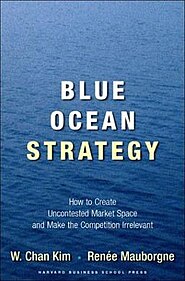
Blue Ocean Strategy is a business strategy book that promotes a systematic approach "for making the competition irrelevant."The authors, W.Chan Kim and Renée Mauborgne, are professors of Strategy and Management at INSEAD. A core idea is to create a leap in value for both the company and its buyers by breaking the differentiation/low cost trade-off and to align product value and profit propositions.

Blue Ocean Strategy is the result of a decade-long study of 150 strategic moves spanning more than 30 industries over 100 years (1880-2000). In addition to retrospective case studies, the book offers theoretical approaches and practical tools to create and capture "blue oceans". Kim and Mauborgne argue that tomorrow’s leading companies will succeed not by battling competitors, but by creating “blue oceans” of uncontested market space ripe for growth.

This best seller sold more than a million copies in its first year of publication and is being published in 39 languages.

Straight From The Gut (Summaries)


Download Here


Amazon.com's Best of 2001
It's hard to think of a CEO that commands as much respect as Jack Welch. Under his leadership, General Electric reinvented itself several times over by integrating new and innovative practices into its many lines of business. In Jack: Straight from the Gut, Welch, with the help of Business Week journalist John Byrne, recounts his career and the style of management that helped to make GE one of the most successful companies of the last century. Beginning with Welch's childhood in Salem, Massachusetts, the book quickly progresses from his first job in GE's plastics division to his ambitious rise up the GE corporate ladder, which culminated in 1981. What comes across most in this autobiography is Welch's passion for business as well as his remarkable directness and intolerance of what he calls "superficial congeniality"--a dislike that would help earn him the nickname "Neutron Jack." In spite of its 496 pages, Jack: Straight from the Gut is a quick read that any student or manager would do well to consider. Highly recommended. --Harry C. Edwards

Winning

Download here

Editorial Reviews
Amazon.com
If you judge books by their covers, Jack Welch's Winning certainly grabs your attention. Testimonials on the back come from none other than Warren Buffett, Bill Gates, Rudy Giuliani, and Tom Brokaw, and other praise comes from Fortune, Business Week, and Financial Times. As the legendary retired CEO of General Electric, Welch has won many friends and admirers in high places. In this latest book, he strives to show why. Winning describes the management wisdom that Welch built up through four and a half decades of work at GE, as he transformed the industrial giant from a sleepy "Old Economy" company with a market capitalization of $4 billion to a dynamic new one worth nearly half a trillion dollars.

Welch's first book, Jack: Straight from the Gut, was structured more as a conventional CEO memoir, with stories of early career adventures, deals won and lost, boardroom encounters, and Welch's process and philosophy that helped propel his success as a manager. In Winning, Welch focuses on his actual management techniques. He starts with an overview of cultural values such as candor, differentiation among employees, and inclusion of all voices in decision-making. In the second section he covers issues around one's own company or organization: the importance of hiring, firing, the people management in between, and a few other juicy topics like crisis management. From there, Welch moves into a discussion of competition, and the external factors that can influence a company's success: strategy, budgeting, and mergers and acquisitions. Welch takes a more personal turn later with a focus on individual career issues--how to find the right job, get promoted, and deal with a bad boss--and then a final section on what he calls "Tying Up Loose Ends." Those interested in the human side of great leaders will find this last section especially appealing. In it, Welch answers the most interesting questions that he's received in the last several years while traveling the globe addressing audiences of executives and business-school students. Perhaps the funniest question in this section comes at the very end, posed originally by a businessman in Frankfurt, who queried Welch on whether he thought he'd go to heaven (we won't give away the ending).

While different from the steadier stream of war stories and real-life examples of Welch's first book, Winning is a very worthwhile addition to any management bookshelf. It's not often that a CEO described as the century's best retires, and then chooses to expound on such a wide range of management topics. Also, aside from the commentary on always-relevant issues like employee performance reviews and quality control, Welch suffuses this book with his pugnacious spirit. The Massachusetts native who fought his way to the top of the world's most valuable company was in many ways the embodiment of "Winning," and this spirit alone will provide readers an enjoyable read. --Peter Han

Differentiate Or Die

Download here
Review by amazon

There are no two ways about it with Jack Trout. Either you've got a product or service that you can say is different, or you don't have much at all. In today's global marketplace and at its lightning-fast rate of change, there's no point in inventing and presenting a product only to sit back and hope that consumers everywhere will discover its greatness. It's not simply about what you or your product can do, it's about what you do differently from everyone else. Coauthors Trout and Steve Rivkin say it all in their no-holds-barred title, Differentiate or Die. A disciple of the marketing guru Rosser Reeves, who introduced the concept of the "unique selling proposition," Trout relays his vision of what can help you differentiate in blunt, tell-it-like-it-is prose. First he breaks the bad news that product quality, advertising creativity, price advantage, and breadth of product line are rarely successful ways to differentiate your business. Consumers expect the best quality, he says; they don't think it's a bonus. In the same vein, your competitor can slash prices just as quickly as you. After dismissing these common marketing techniques as futile, Trout concentrates on which differentiating ideas will set you apart from the pack: Being first (and staying there), owning a discernible attribute, having a heritage, becoming the preference of a particular consumer group, or even being the most recent arrival in a product arena are just some of these useful differentiates. Though the book's fast and quippy narrative style may leave some readers looking for more substance behind his adamant assertions, Trout's recommendations act as inspirational spurts of energy. A slim manual packed with punchy points, Differentiate or Die won't take you long to read but could make a lasting--you guessed it--difference to the success of your business. --S. Ketchum --This text refers to an out of print or unavailable edition of this title.